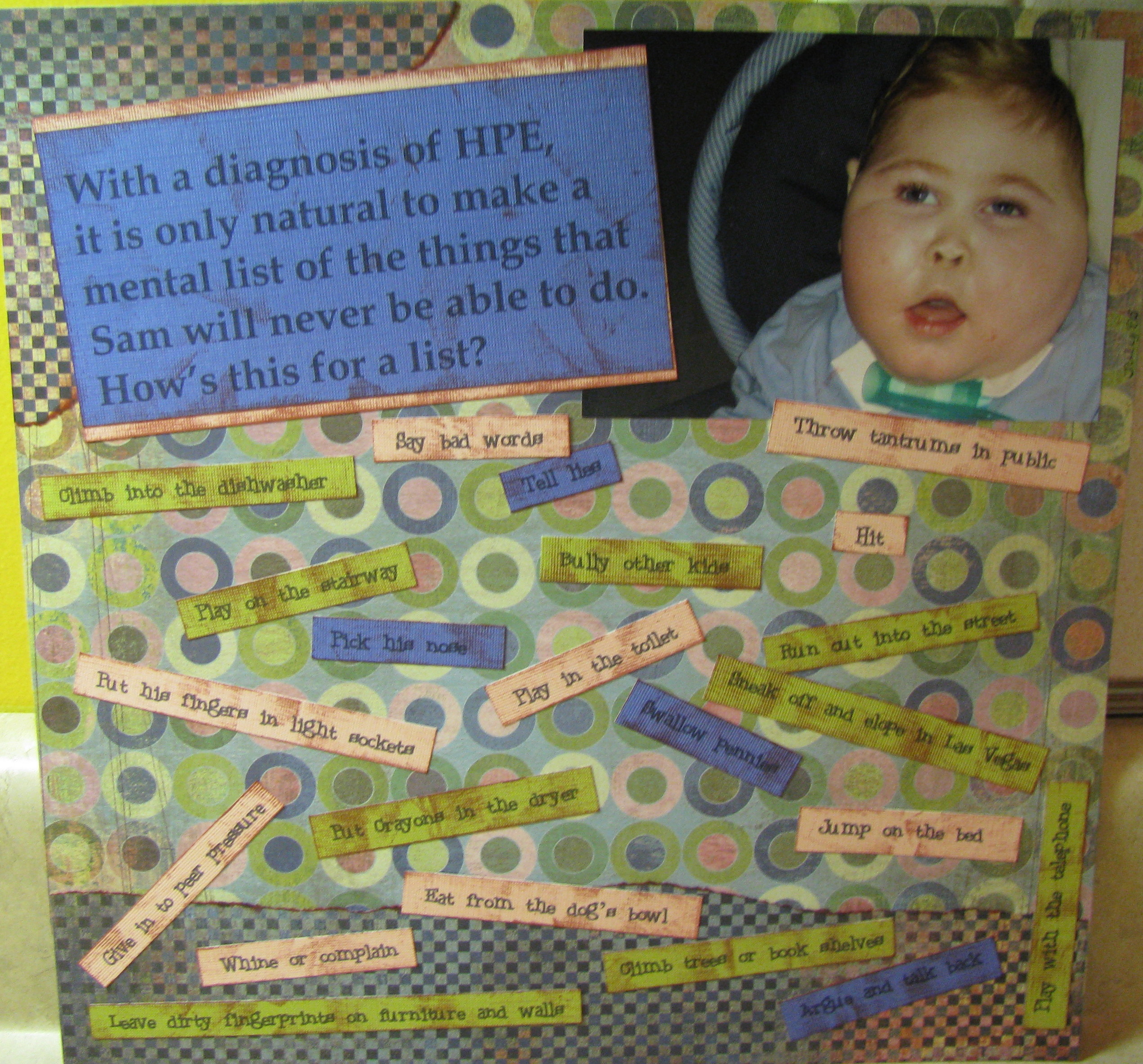
How’s this for a list?

29 Aug

I thought I’d share one of the hundreds of scrapbook pages I’ve created over the years.

When we received the diagnosis of Sammy’s HPE, we were given examples of the things that a child with HPE might never be able to do.  Some of them were easier to accept than others, but by far the hardest to hear was, “You need to be prepared to love a child who may never be able to show you love in return.”  That one cut to the core.

The first meeting I had with Sammy’s neurologist took place in my hospital room just two days following Sammy’s birth.  He came into my room, introduced himself, and he sat down to talk with me.  I can remember his exact words. . . “I’ve just come from evaluating your son and reading the scans of his brain.  As was expected from the prenatal ultrasound, I can confirm that he does have holoprosencephaly.  As a result of that diagnosis, I could give you a list of all of the things that your son will never be able to do; however, I don’t do that anymore.  I find that as soon as I say those things, these kids will prove me wrong; so, I’ve learned to just keep my mouth shut and let these kids show me what they are going to do.”  In that moment, I knew that this physician would be a great member of Sammy’s medical team.

I had done my homework, and I knew very well all of the many things that Sammy would never be able to do.  Being somewhat sarcastic at times, I decided one day to make a list of the things that Sammy would never be able to do compared to other “typical” children.  Here are a few of my favorites that I incorporated into a scrapbook page:

Say bad words
Tell lies
Play in the toilet
Put his fingers in light sockets
Eat from the dog’s bowl
Swallow pennies
Bully other kids
Put crayons in the dryer
Climb into the dishwasher
Sneak off and elope in Las Vegas

Extra, extra! Read all about it…

24 Aug

“Don’t do anything or find yourself in any situation that you wouldn’t want reported on the front page of the local newspaper.”

That was the often-repeated motherly advice given to one of my friends throughout her teen years.  As parents, we never want to see our child’s name in the newspaper for something negative, but instead, we hope that our children will be recognized publicly for good works and accomplishments. It’s a joy to see their name in print, and when it happens, we buy multiple copies of the newspaper, we email the online version to our friends, and we grab the scissors and glue so that we can add it to the scrapbook.

15 years ago, two of my very good friends experienced the death of their 4 week-old infant to SIDS. As I read her obituary in the newspaper, it saddened me that this would be the only time my friends would see their daughter’s name in the newspaper. No awards, no dean’s list, no game-winning home runs. Simply an obituary.

When we learned that Sammy would be born with HPE, we understood that he would have profound mental impairments, and we grieved the fact that he would never be a scholar, athlete or leader. Although I never vocalized it, in my heart I feared that the only public proof of his existence would be simply an obituary.

One of my favorite verses in the Bible is Psalm 37:4,“Delight in Me, and I will give you the desires of your heart.” On a spring morning in 2005 just after Sammy’s 2nd birthday, I received a desire of my heart as Sammy’s name and a color photo appeared on the front page of the Metro & State section of the Indianapolis Star. Although I hadn’t expressed my obituary fears to anyone, the Lord knew my heart’s secret desire, and He provided me with a moment of joy and pride to see my son in the newspaper.

When it became time to write Sammy’s obituary, he had already made the newspaper, been featured on our local tv news, had his story told on the radio, along with other miscellaneous newsletters, websites, and more. The obituary was no longer simply about Sammy’s death as I had once feared; instead, his obituary became a tribute to how he lived.

(The infant I mentioned above, Miss Mary Clare Hook, has had her name published in the newspaper several times since her passing as her parents have been active in fundraising and awareness campaigns to support SIDS research. She may have lived only 1 month and 2 days, but she still remains in my heart 15+ years later.)

“…we just want it to be healthy.”

23 Aug

It’s a question frequently asked of expectant parents, “Do you want a boy or a girl?” At some point in time, we have either heard this familiar answer or we have used the statement ourselves to answer that question, “We don’t have a preference; we just want it to be healthy.”

It sounds like a good answer, but I’ve often wanted to ask the follow-up question, “But, what if it isn’t healthy? Then what?” I don’t say that to be critical or condescending, but as someone who has found herself in the position of giving birth to an unhealthy baby, I wonder if some expectant parents have really thought about how they would answer that question.

Sammy spent nearly 4 months in the neonatal ICU following his birth. It was a rather large NICU that could accommodate 60+ babies at any one time, and it was often at capacity. Except for the day following my c-section due to my own health crisis and the day following my gall bladder removal 5 weeks later, I was at Sammy’s bedside daily. I saw newborn babies admitted for observation following c-section deliveries. I saw micro-preemies who were too fragile to be held. I saw twins, triplets, and quads. I saw infants born with drug addictions. I saw babies needing oxygen, intubated and on ventilators, with feeding tubes, and with scars indicating that they had needed surgery of some kind. I saw babies leave the NICU to go home with their parents, and I saw parents leave the NICU with empty arms.

They say that “home is where the heart is”; well, during those four months, my heart was in that NICU. After spending a little while there, I began to feel overwhelmed and depressed by the fact that it seemed as if every baby was sick because that is all I saw every day. Finally, a little reality kicked in and I reminded myself that healthy babies were being born every day in that hospital and also in hospitals and homes around the world.

I think maybe I spent a little too much time focused on and worrying about babies who were sick, but I also think that we sometimes take it for granted that pregnancies will go perfectly and babies will be born healthy.  But, what if?

Life in the NICU